Hypertrophic pyloric stenosis
Patient Presentation & Demographics
Clinical History & Presentation: Patient presented with characteristic clinical findings consistent with suspected Hypertrophic pyloric stenosis. Multimodal diagnostic imaging was performed to characterize anatomic involvement and guide therapeutic management.
Systematic Imaging Findings
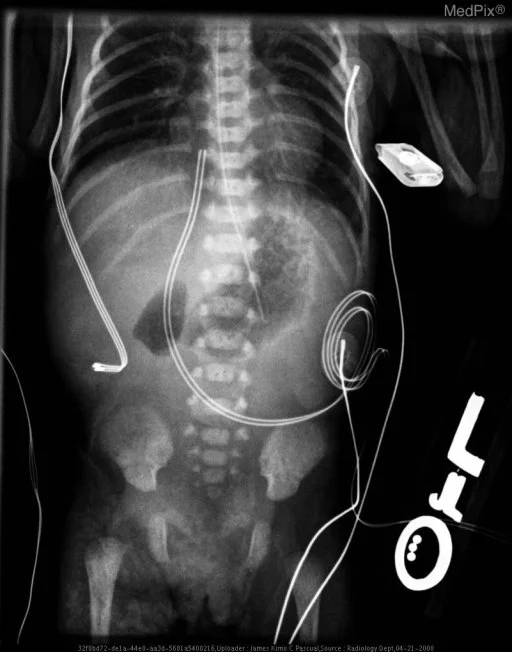
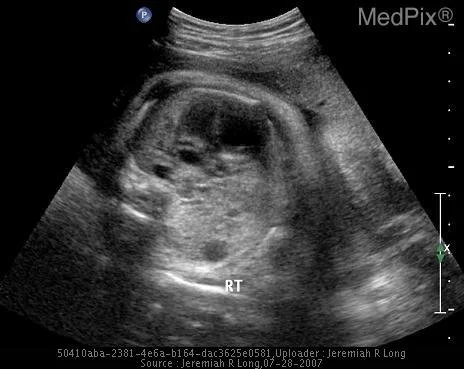
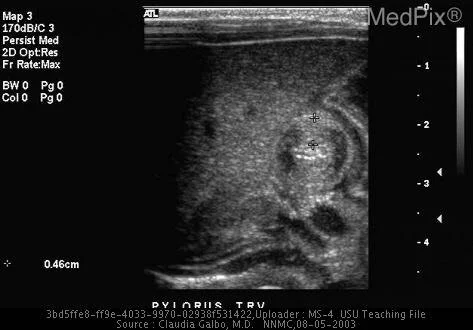
Modality & Anatomic Assessment (Computed Tomography / Radiography): Pediatric diagnostic imaging systematically assesses skeletal developmental maturation, neonatal bowel gas distribution patterns, visceral organ proportions, and anatomic symmetry relative to gestational and chronologic age norms. Key Observational Findings: There is a long segment of increase muscular thickness with coaptation of the lumen of the pylorus. The length of the pyloric canal is 1.5 cm. This is greater than the 1.2cm normal length. The muscle thickness is .46cm which exceeds the greater than or equal to 3mm thickness of normal. During the study40 cc of water was instilled into the stomach, and no fluid was seen to pass through the pylorus.
Challenge: What Is the Primary Diagnosis?
Evaluate the patient presentation, systematic radiologic findings, and multi-frame imaging series above. Test your clinical reasoning before revealing the definitive diagnosis, hallmark differential criteria, and board pearls.
Hypertrophic pyloric stenosis
Differential Diagnosis (DDx) • Key Clinical Hallmarks
Pediatric Intussusception
Distinguishing Radiologic Hallmark: Target or pseudokidney sign on sonography demonstrating telescoping of invaginated bowel loop within outer recipient bowel.
Midgut Volvulus
Distinguishing Radiologic Hallmark: Corkscrew sign on upper GI series with clockwise whirlpool twist of mesenteric vessels on Doppler and abnormal position of duodenojejunal flexure.
Hypertrophic Pyloric Stenosis
Distinguishing Radiologic Hallmark: Pyloric muscle thickness > 3 mm and channel length > 14 mm with classic target/donut sign on graded compression sonography.
Hirschsprung Disease
Distinguishing Radiologic Hallmark: Rectosigmoid transition zone with cone-shaped caliber disparity between narrow aganglionic segment and dilated proximal ganglionic colon.
High-Yield Clinical Pearls & Management Guidelines
In neonatal intestinal obstruction, the radiographic "double bubble" sign is pathognomonic for congenital duodenal atresia. In infants with non-bilious projectile vomiting, sonographic pyloric muscle thickness > 3.0 mm and channel length > 14 mm confirms hypertrophic pyloric stenosis (HPS). ACR Communication Urgency: Tier 1 for midgut volvulus or intussusception.