History, clinical course, and imaging findings compatible with tennis leg
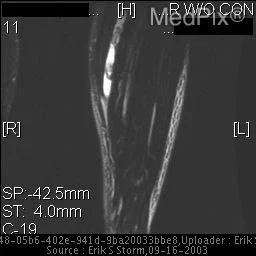
Patient Presentation & Demographics
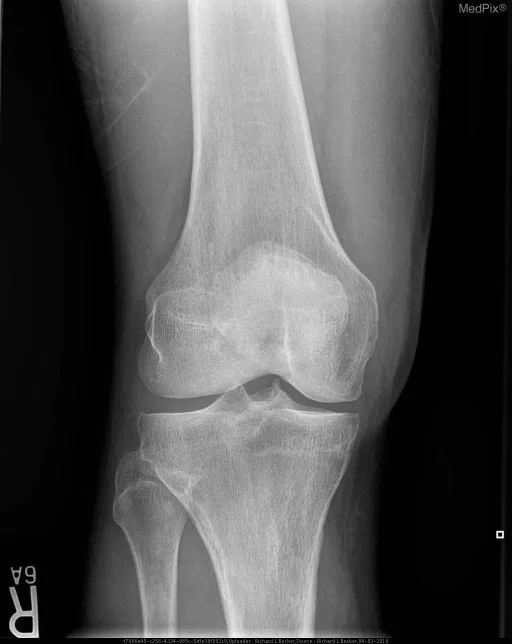
Clinical History & Presentation: Patient presented with characteristic clinical findings consistent with suspected History, clinical course, and imaging findings compatible with tennis leg. Multimodal diagnostic imaging was performed to characterize anatomic involvement and guide therapeutic management.
Systematic Imaging Findings
Modality & Anatomic Assessment (Magnetic Resonance Imaging (MRI)): Musculoskeletal series systematically evaluate cortical bone integrity, trabecular architecture, joint space width, subchondral bone mineral density, and adjacent soft-tissue envelopes. Multiplanar projections detect occult fractures, periosteal reactions, and articular alignment discrepancies. Key Observational Findings: Large fluid collection between the medial head of the gastrocnemius and soleus muscles, within which are areas of dark T2 signal consistent with hemosiderin deposition. Large fluid collection between the medial head of the gastrocnemius and soleus muscles, within which are areas of dark T2 signal consistent with hemosiderin deposition.
Challenge: What Is the Primary Diagnosis?
Evaluate the patient presentation, systematic radiologic findings, and multi-frame imaging series above. Test your clinical reasoning before revealing the definitive diagnosis, hallmark differential criteria, and board pearls.
History, clinical course, and imaging findings compatible with tennis leg
Differential Diagnosis (DDx) • Key Clinical Hallmarks
Erosive Osteoarthritis
Distinguishing Radiologic Hallmark: Non-uniform joint space narrowing with subchondral sclerosis, osteophyte formation, and gull-wing gullies in interphalangeal joints.
Rheumatoid Arthritis
Distinguishing Radiologic Hallmark: Symmetric marginal erosions, periarticular osteopenia, and uniform joint space loss without osteophyte proliferation.
Acute Osteomyelitis
Distinguishing Radiologic Hallmark: Permeative cortical bone destruction, multilayered periosteal reaction, subperiosteal abscess, and devitalized sequestrum formation.
Osteosarcoma
Distinguishing Radiologic Hallmark: Aggressive periosteal reaction (Codman triangle, sunburst appearance) with cloud-like osteoid tumor matrix and soft tissue extension.
High-Yield Clinical Pearls & Management Guidelines
In elderly patients presenting with hip pain after low-energy trauma and negative initial radiographs, immediate non-contrast MRI or CT is indicated to exclude occult femoral neck fracture. The "fallen fragment sign" in a lytic bone lesion is pathognomonic for a pathologic unicameral bone cyst. ACR Communication Urgency: Tier 2 for unstable trauma, Tier 3 for routine staging.
Related Clinical Challenges in Musculoskeletal & Orthopedics
 2 images
 4 images
 2 images
 9 images